Categories
News

The FAIRsharing community at RDA Plenary 27
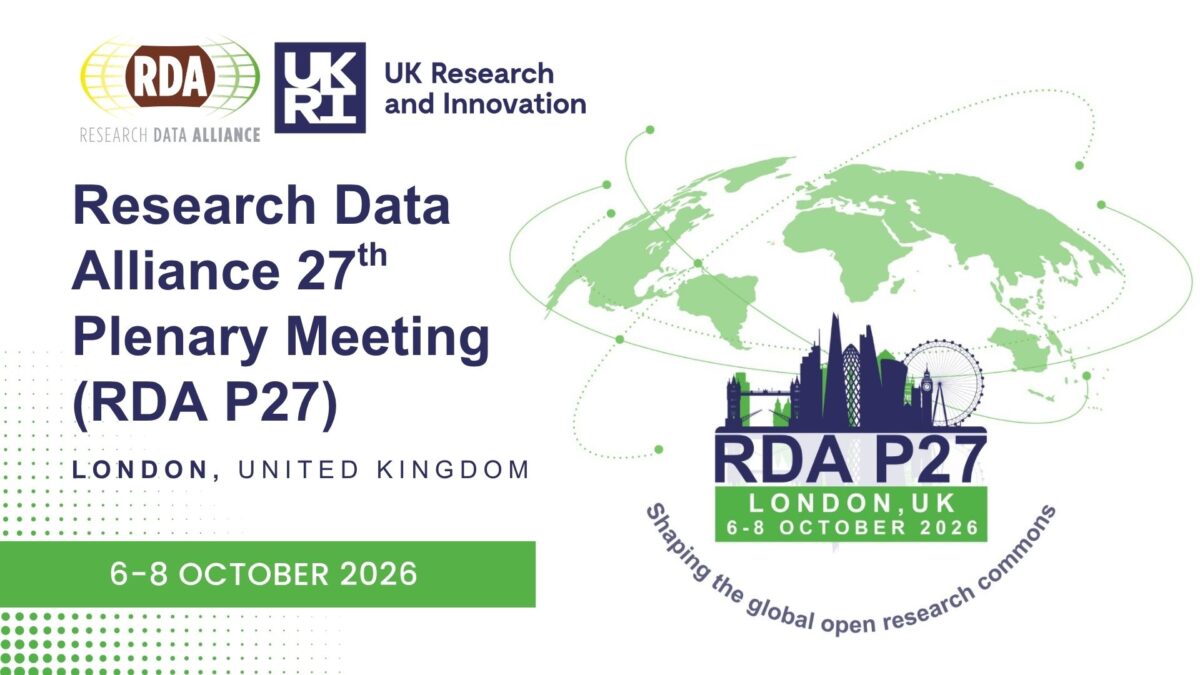
FAIRsharing is looking forward to attending the RDA 27th Plenary (P27) in London, running from October 6-8 2026. We have a wide variety of stakeholders and collaborators that, like us, are active within the RDA and the plenaries are a great way to spend some time with them on topics that matter to the RDM […]

Categories
News

FAIRassist: registry of FAIR benchmarks and metrics

Although more than 30 FAIR assessment and assistance tools have emerged in recent years (https://fairassist.org/tools), they often exhibit widely different results due to the lack of transparency about what is actually being checked and how it is measured. FAIR is intentionally expressed as a set of high-level principles rather than a technical standard, allowing different […]

Categories
News

FAIRsharing summer holidays

It’s time for our team to disconnect: log out of Teams, Zoom, Zulip and emails and have a well deserved summer break! We couldn’t leave without first giving our usual big THANK-YOU to all our collaborators and friends. We’ll see you all in September! In the Northern Hemisphere, summer has arrived, and around the world […]

Categories
News

Community Champions in the Spotlight: Improved Connections with FAIRsharing and RDMkit

Our spotlight series allows us to shine a light on the people who work with FAIRsharing. Today we’re focusing on Federico Bianchini, our Community Champion for the ELIXIR Research Data Management Community. Detailed information on the programme is available at the FAIRsharing Community Champions homepage. With thanks to Federico, who co-authored this blog with the FAIRsharing Team. Federico […]

Categories
News

Defining FAIR for UK Institutional Repositories: A Community Collaboration between FAIRsharing and UKRN

Defining and testing a common FAIR compliance process for institutional repositories

Categories
News

Building Community-Specific FAIR Benchmarks: Insights from the OSTrails project

In this joint blog post, John Shepherdson (Project Consultant, CESSDA ERIC) and Allyson Lister (FAIRsharing Coordinator – Content & Community, University of Oxford; and ELIXIR-UK) describe a recent workshop they co-led where community representatives began the creation of Benchmarks, to assist with FAIR-compliance, tailored to their specific requirements. On Friday, November 28th, the OSTrails project hosted […]

Categories
News

Perspectives on registry-level curation in FAIRsharing

In this guest blog, FAIRsharing Community Champion for RDM and Social Sciences and Humanities David Tomkins writes about database and standard curation, completed as part of his recent short-term contract with FAIRsharing. Having been a FAIRsharing Community Champion for the Humanities and Social Sciences since 2023, I joined the FAIRsharing team as a Curator in February 2025 […]

Categories
News

Summer holidays at FAIRsharing

It’s time for our team to disconnect: log out of Teams, Zoom, Zulip and emails and have a well deserved summer break!We couldn’t leave without first giving our usual big THANK-YOU to all our collaborators and friends. We’ll see you all in September! In the Northern Hemisphere, summer has arrived, and around the world universities […]

Categories
News

Enabling publisher collaboration for enhanced data policy enforcement

This is a guest blog by Dr Rebecca Taylor-Grant, where she describes recent work on the TIER2 Editorial Reference Handbook. For more information, please see the publication:Taylor-Grant, Rebecca & Cannon, Matthew & Lister, Allyson & Sansone, Susanna-Assunta. (2025). Making reproducibility a reality by 2035?: Enabling publisher collaboration for enhanced data policy enforcement. International Journal of […]

Categories
News

FAIRsharing adds a new field: digital research object type

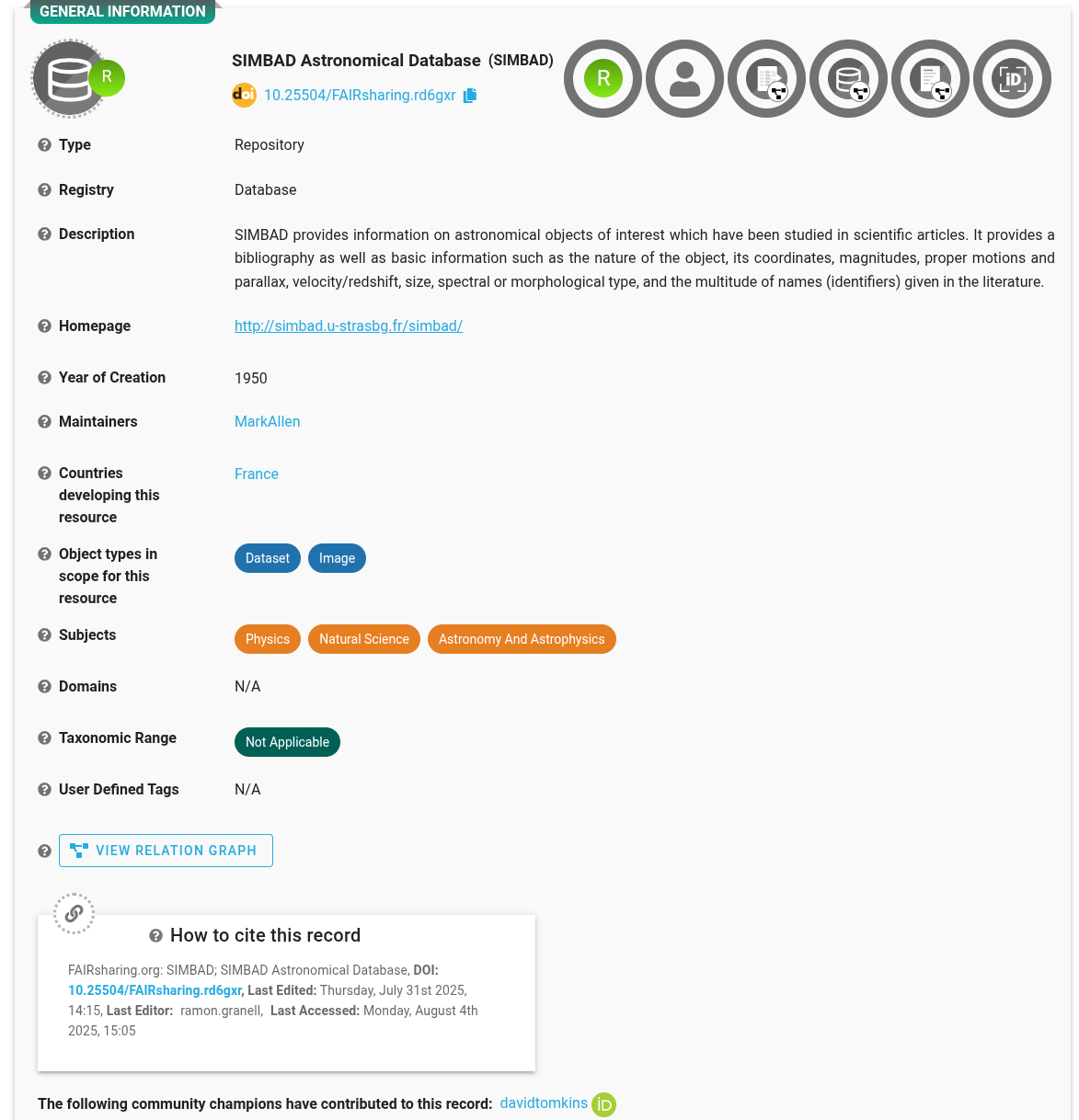
FAIRsharing’s new ‘Object type’ allows every registered resource to declare the type(s) of digital object it supports. Does your repository store datasets, images, multimedia or publications? Is your community ontology intended to be used to tag datasets, or is it completely agnostic of the type of object within its scope? Read on to find out more about this new field.