A collaboration between the University of Oxford’s FAIRsharing and Oxford University Research Archive (ORA) teams has successfully delivered a new approach to evaluating and improving the FAIRness of research datasets. The work, undertaken as part of Oxford’s Research Practice Programme, has also supported a wider collaboration with the UK Reproducibility Network (UKRN), establishing a shared approach to FAIR assessment for institutional repositories across the UK.
The FAIR Principles, which aim to make research data Findable, Accessible, Interoperable and Reusable, are increasingly embedded in research policy and practice. However, assessing whether research data meets these principles remains challenging. Existing FAIR assessment tools can produce inconsistent results, making it difficult for researchers and repository managers to understand what is being evaluated and how FAIRness can be improved.
In May 2026, Oxford reported on its work to address these challenges by developing a transparent, community-defined FAIR benchmark for institutional repositories. This work has now been implemented locally within Oxford and reviewed by the UKRN.
FAIR evaluation becomes part of ORA
The collaboration between FAIRsharing, based at the Oxford e-Research Centre, and ORA, managed by the Bodleian Libraries, has produced a set of FAIR metrics, automated tests and a scoring system that can evaluate the metadata describing research datasets.
Using the Assessment Interoperability Framework (Assess-IF) developed through the European Open Science Cloud’s OSTrails project, the teams have created a reusable FAIR evaluation process that separates the community’s definition of FAIR from the software used to test it.
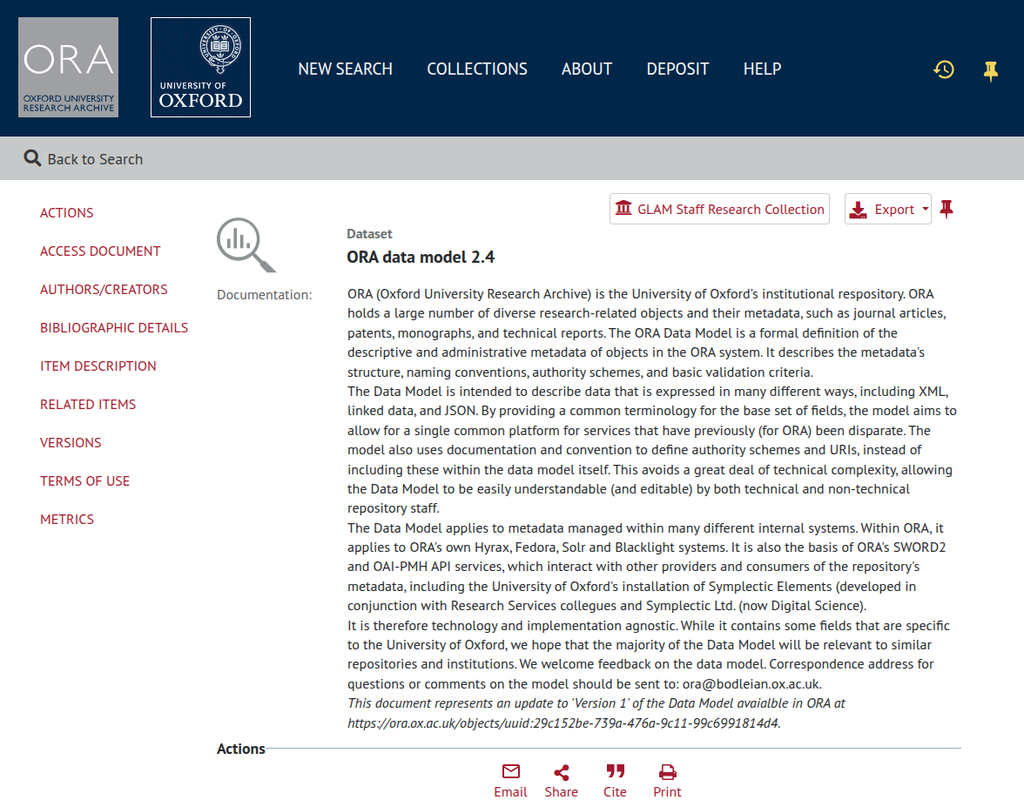
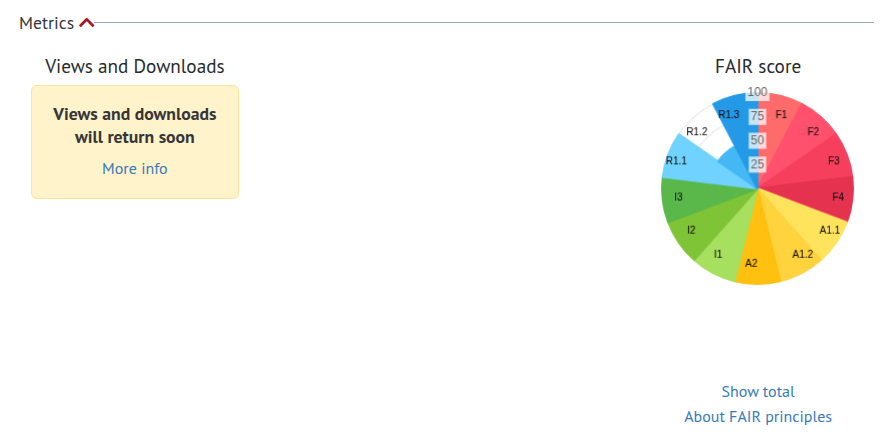
The resulting assessment service has been integrated into ORA’s existing workflows. When a new or updated dataset record is published, its metadata is automatically evaluated against the benchmark. The results are displayed on the public ORA record, including an overall FAIR score and a breakdown across the four FAIR categories (Figure 1). Depositors also receive an email explaining their results and directing them towards further information and guidance.
Importantly, these changes do not require researchers to alter how they deposit their data, or add additional steps to the existing repository review process.
Initial evaluations demonstrate the potential of the approach. By 20 October 2026, 1,898 ORA datasets had been assessed, with 23 achieving full compliance with the benchmark. Of the 13 under evaluation, ORA datasets averaged at least 80% in all but 4 of the FAIR Principles. The results also highlight areas where improvements to metadata and repository workflows could increase FAIRness (particularly around I3 and R1.2), providing a baseline against which future progress can be measured.
The next phase will focus on learning from these results, expanding to additional research object types and developing more targeted guidance to help researchers understand how they can improve the FAIRness of their datasets.
From Oxford to a shared UKRN benchmark
This Autumn has also seen the successful completion of the first phase of the FAIR Institutional Repository Metrics (FIRM) project, undertaken through the UKRN Open Research Programme.
Building on the original Oxford work, FIRM brought together contributors from Cardiff University, the University of Glasgow, the University of Sheffield and Oxford, alongside observers from five additional UK universities.
The participating institutions reviewed and refined the FAIR metrics against their own repository requirements. Despite using different repository platforms, including Figshare and ePrints, the collaboration identified substantial agreement on how the FAIR Principles should be interpreted for institutional repository datasets.
The resulting FAIR Benchmark for Institutional Repository Datasets provides a transparent, community-reviewed starting point that other institutions can adopt or adapt. It distinguishes between FAIR requirements provided through repository infrastructure and those dependent on information supplied by researchers, helping institutions identify both technical improvements and opportunities for better depositor guidance.
Supporting wider adoption
The Oxford and UKRN work demonstrates how FAIR assessment can move from opaque, tool-specific scoring towards transparent, community-governed evaluation and assistance.
The benchmark, metrics, tests and associated technical components have been developed with reuse in mind. Institutions can review the benchmark against their own requirements, identify opportunities for improvement and, where appropriate, integrate automated FAIR evaluation into their existing systems.
Further engagement is planned through UKRN, with opportunities for institutional repository managers, research data professionals and Research Software Engineers to explore how the approach could be applied within their own institutions.
Together, the successful Oxford implementation and the FIRM collaboration provide a foundation for more consistent, transparent and actionable FAIR assessment across the UK research community.