FAIRsharing is a manually-curated, high-quality registry of standards, databases, and policies, and we are constantly improving the depth and coverage of our content. We have recently completed a massive curation effort that complements our addition of the new object type field. Efforts of curators, champions and the maintainer community has resulted in the population of this object type field across our entire registry.
FAIRsharing has over 40 metadata fields, all of which are accessible via our standard and advanced searches. However, because FAIR compliance and resource discovery is driven as much by the type of data you are producing as any of these other fields, the addition of this field will be useful not just to our own user community but also to all users of the tools that integrate our content. By adding a mandatory Object Type field, we have made it significantly easier for you to discover the resources you need. Object types allow you to explore our records in a variety of new ways, from policies requiring Data Management Plans, or repositories storing Images.
Because this field is now complete curated and mandatory across all record types except for collections, it is accessible via our API to all third-party tools that integrate with us (take a look at an example ‘user journey’ that includes tool integrations in our documentation for more info about these tools). This means that tools that use our services, such as automated DMP creation tools and FAIR assessment tools, can now programmatically “see” which resources support specific digital objects, helping you stay compliant with funder and institutional policies throughout the research life cycle.
While developing the code for this new field was a technical task, populating it was a significant human undertaking. We currently have over 5,100 approved, non-deprecated records. Many of these are maintained by the community, but for those without active maintainers, our internal FAIRsharing Curation Team and our dedicated Community Champions spent several months checking and validating each entry.
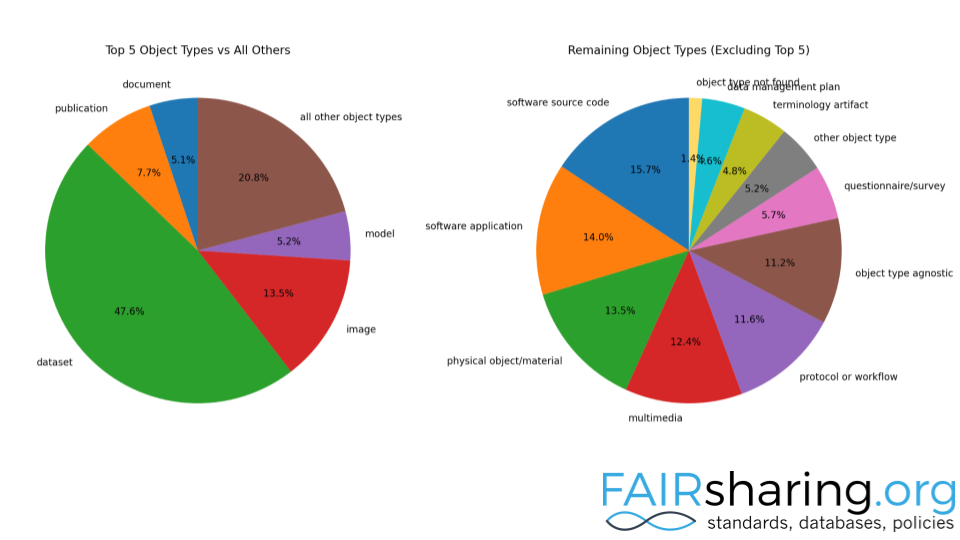
Now that this huge curation task is complete, we’d like to share some numbers with you. Firstly, a look at the total number of object types across databases, standards and policies.
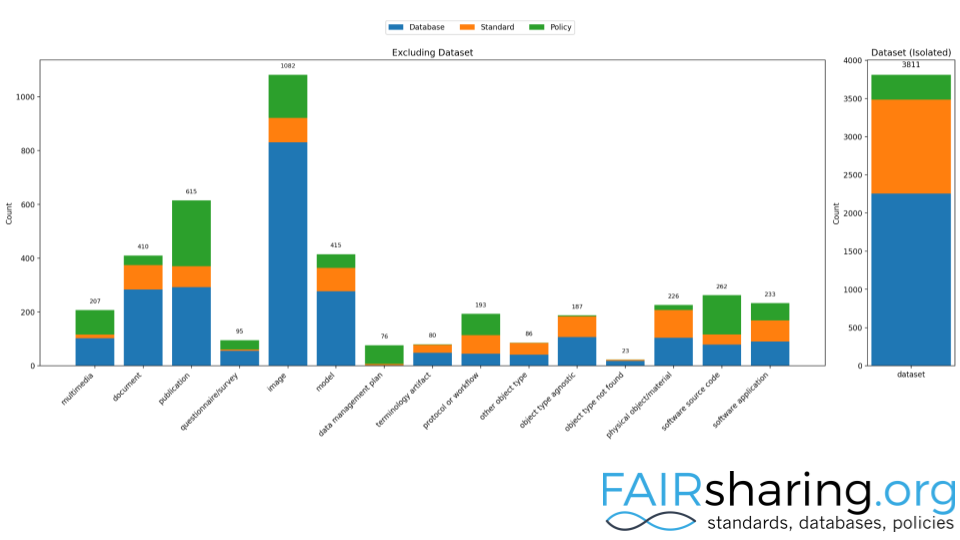
What is clear is the sheer scale of Datasets. With 3,811 assignments, they represent over 50% of the total object types in FAIRsharing. With regards to software, Software Source Code has more than double the number of policies (145) compared to Software Applications (65). Although we’re not sure why, perhaps this shows that policymakers are increasingly focusing on the reproducibility of research through open code, rather than just the availability of a finished software tool.
In the top 5 with Datasets, Documents and Publications, Images (1,082) and Models (415) represent the largest of what could be called the ‘non traditional’ research outputs. The over-representation of Dataset, Software and Publications within policies indicates that while we are very good providing regulation and guidance to the research community relating to these object types, we are still in the earlier stages of building the same level of policy and standard infrastructure for other, less traditional research objects.
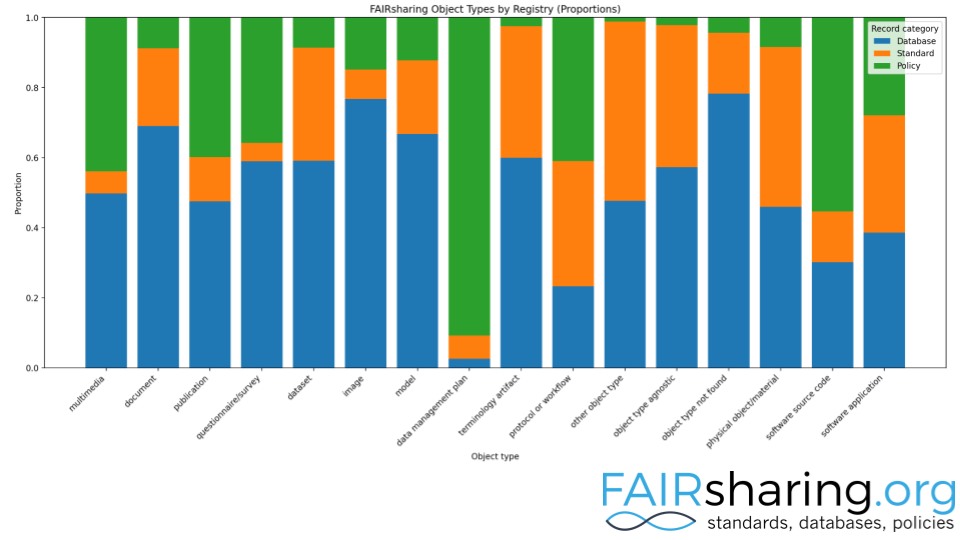
The graph of proportional representation of object types shows that DMPs are highly represented in policies, while image object types are most often found in database records. There is also a relatively equal distribution of protocol/workflow objects across all three registries. Full details used to generate these charts are included in the table below. The sum of the object types is higher than our total number of records because many records support more than one object type (for example, a database might store both Datasets and Images).
| Object Type | Database | Standard | Policy | Total |
| Dataset | 2253 | 1230 | 328 | 3811 |
| Image | 830 | 91 | 161 | 1082 |
| Publication | 292 | 78 | 245 | 615 |
| Model | 277 | 87 | 51 | 415 |
| Document | 283 | 91 | 36 | 410 |
| Software Source Code | 79 | 38 | 145 | 262 |
| Software Application | 90 | 78 | 65 | 233 |
| Physical Object/Material | 104 | 103 | 19 | 226 |
| Multimedia | 103 | 13 | 91 | 207 |
| Protocol or Workflow | 45 | 69 | 79 | 193 |
| Questionnaire/Survey | 56 | 5 | 34 | 95 |
| Other Object Type | 41 | 44 | 1 | 86 |
| Terminology Artifact | 48 | 30 | 2 | 80 |
| Data Management Plan | 2 | 5 | 69 | 76 |
| Object Type Agnostic | 107 | 76 | 4 | 187 |
| Object Type Not Found | 18 | 4 | 1 | 23 |
| Total | 4628 | 2042 | 1330 | 7431 |
You can now use these object types in our Advanced Search and faceted searching to narrow down your results. If you are a record maintainer, please ensure that the object types assigned to your record accurately reflect your resource’s current capabilities.
We would like to extend a huge thank you to our maintainers, Community Champions and the FAIRsharing team themselves (especially David Tomkins and Lea Girard) for their curation efforts. Ramon Granell led the technical and Allyson Lister the curatorial work.